99 focused opportunities
Commercially minded starting points across 11 markets.
2026 EDITION THE NO CODE FOUNDER PLAYBOOK
You can build in 2026.
Start by choosing what’s worth building.
Find focused opportunities, validate demand and turn one valuable workflow into your first product—with AI and no code tools.
Digital PDF · International edition · One time payment
Target buyers ✦ Product blueprints ✦ Copy ready prompts ✦ Validation plans
01 / THE REAL BOTTLENECK
The tools are everywhere. A clear business decision is harder to find. Which buyer, which painful workflow, which first feature—and why would anyone keep paying?
“I cannot build
software.”
“I can build almost anything.
But what is worth building?”
This playbook was created for the second problem.
Get the Full Playbook02 / A SMALLER MARKET. A CLEARER JOB.
Do not compete with the model. Package a valuable workflow around it.
A specific buyer. Their stored context. Their approvals. Their history. A recurring job worth doing well.
03 / INSIDE THE 330 PAGES
Each idea connects the business decision to an execution plan. Here is what that looks like in practice.
Commercially minded starting points across 11 markets.
Know who the product is built to serve.
Find the repeated job behind the feature.
Differentiate through a narrow customer or process.
Compare five directional opportunity factors.
Match the first version to your resources.
Plan a model connected to customer value.
Understand customer counts, before costs.
Keep the first useful product focused.
Understand the architecture behind the build.
Start where your buyers already gather.
Make context part of your advantage.
Know where human review belongs.
Give an AI builder a structured specification.
Turn assumptions into buyer conversations.
Measure use and willingness to pay.
04 / REAL PAGES. REAL DEPTH.
Explore three actual pages from the ebook: the opportunity, the product blueprint and the build prompt.
Turn scripts, references and past CTR notes into creative hypotheses, A/B briefs and revision logs.
Editorial scores are directional judgments, not audited market statistics. Pricing and revenue examples are planning illustrations, not earnings promises.
Unlock the 330 Page Guide05 / THE CONNECTED PLAN
Who is the customer?
What repeated problem costs them?
Why should this product exist?
What is the smallest useful version?
What tools could build it?
Where are the first customers?
What do you give the AI builder?
What will you test before investing?
06 / LESS BLANK PAGE. MORE BLUEPRINT.
Each prompt connects product goals, users, workflow, data and validation.
// Thumbnail Experiment Brief OS
Build a production ready SaaS web app called “Thumbnail Experiment Brief OS” for YouTube teams, thumbnail designers, video agencies.
The MVP must include:
→ Script intake
→ Competitor reference board
→ Concept hypothesis cards
→ A B test brief export
→ Revision memory
Before building, return a concise product plan, database schema, page map and acceptance checklist.
Choose an idea. Adapt the assumptions. Ask the builder for a plan. Then implement and test in small steps.
Choose an Idea. Start Building.Prompts are tool agnostic. Production quality still requires testing, review and iteration.
07 / FIND YOUR MARKET
Start with the market you understand—or the buyers you can reach. The ebook spans 11 distinct categories.
Creative operations, sponsor workflows and audience insight.
Scope, revisions, delivery and commercial clarity.
Inquiries, follow-ups and everyday service workflows.
Sales learning, campaign operations and follow-through.
Customer questions, returns and store operations.
Internal knowledge, coordination and reviewed people workflows.
Document handling, invoices and recurring administration.
Maintenance, property operations and organised information.
Learning workflows, training support and content upkeep.
Specific operating problems in specialist businesses.
Quality checks, cost visibility and tools for AI teams.
Your advantage may already be in your existing network.
Explore All 99 Ideas08 / A SMALL TASTE OF THE LIBRARY
Turn scattered inputs into a testable creative direction.
Bring audience fit and sponsor deliverables into one workspace.
Give strong opening ideas a useful home.
Find repeated audience questions hiding in the comments.
Make vague feedback easier to act on.
Spot when the next request changes the agreed job.
Find the work quietly eroding project margins.
Give missed inquiries a clear next step.
Keep promising quotes from fading into silence.
Turn incoming questions into structured next actions.
Make lost opportunities useful for the next conversation.
Organise signals that a creative needs a refresh.
Learn what keeps coming back—and why.
Connect internal answers to their source documents.
Bring consistency to outstanding invoice follow-ups.
Turn incoming issues into a clearer repair queue.
Find when a prompt change breaks a useful result.
Make model usage and spending easier to see.
more structured opportunities
inside the full playbook.
09 / THE OPPORTUNITY FILTER
The goal is not to fall in love with an idea. Kill weak ideas quickly and concentrate your time on stronger opportunities.
An interactive illustration of the five-factor framework. Scores help you shortlist; customer evidence decides.
10 / BEFORE THE FIRST FEATURE
Can you reach 20 target buyers this week?
Does the problem repeatedly cost time, money, risk or attention?
Can the first version solve one complete job?
Can you ask for payment before building the full platform?
11 / START WITH PROOF, NOT A BIG BUDGET
Separate lean validation from more complex implementation, so you can plan a sensible first step.
Approximately, to validate
Manual imports. One AI capability. Founder-led onboarding. Start with paid proof.
Approximate planning range
A few integrations, scheduled automation, transactional email and a more polished experience.
Approximate planning range
Complex integrations, richer audit logs, larger volumes and specialist implementation.
USD planning ranges, not quotes. Actual costs vary with tools, APIs, contractors, usage and product complexity.
12 / THE MODERN FOUNDER STACK
An architecture you can understand, without assembling a traditional engineering team.
Turn a workflow into a plan and implementation.
Create and iterate on the product surface.
Keep records and relationships organised.
Protect access to accounts and workspaces.
Connect payment to the product’s value.
Move approved work between systems.
Send useful account and workflow updates.
See whether people complete the core job.
Tool examples and capabilities change. The durable assets are your workflow, customer relationship, data and distribution.
13 / KEEP THE FIRST PRODUCT FOCUSED
Your first SaaS needs to complete one valuable job reliably.
Get the input. Structure the context. Generate a draft. Let a person review. Deliver a useful output.
14 / VALIDATION BEFORE INVESTMENT
Move from polite interest to a repeated, valuable job. The playbook includes a seven day validation sprint for every idea.
Buyer confirms the problem happened recently.
They show you their existing workaround.
They share real sample data or a workflow.
They agree to a pilot, deposit or founding plan.
They use the product again without being chased.
“Cool idea. I would probably use it.”
“Can this work with our existing workflow?”
15 / BUILT FOR YOUR NEXT STEP
For people who want to move from collecting ideas to making a thoughtful business decision.
16 / WHY THIS MOMENT MATTERS
Faster prototyping makes niche selection, positioning, trust and distribution more important.
Lower build friction also creates more competition. A clear buyer and a useful workflow still matter.
17 / THE FIRST CUSTOMER STRATEGY
Choose the idea where you understand the buyer—or can reach them cheaply.
Creator communities, editor networks, channel audits and relevant direct messages.
Local agencies, industry associations, partner referrals and direct outreach.
Professional communities, marketplaces, niche newsletters and direct outreach.
Consultants, implementation partners, trade groups and targeted outbound.
18 / YOUR COMPLETE DIGITAL PACKAGE
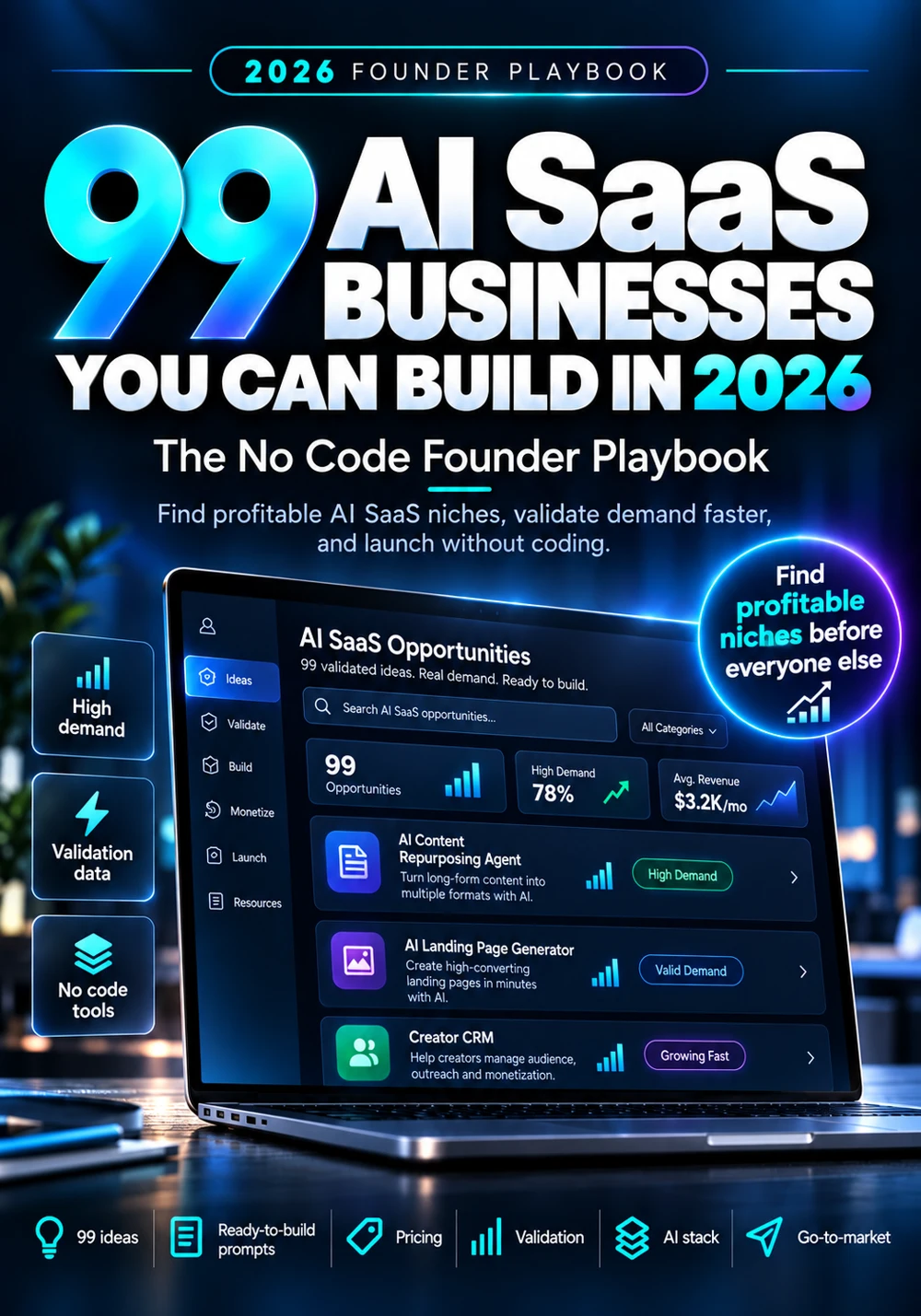
99 AI SaaS Businesses You Can Build in 2026. The complete 330-page international edition.
19 / THE RESEARCH IS ONLY THE BEGINNING
Spend less time assembling scattered starting points. Spend more time testing the assumptions that matter.
20 / ONE PURCHASE. 330 PAGES.
A structured starting point for choosing, validating and building your next AI SaaS product.
Stop collecting random ideas.
Start making a better business decision.
Digital ebook · International edition
Educational guidance, without income guarantees.
One time payment
Checkout and digital delivery via Payhip
21 / A FEW GOOD QUESTIONS
Clear answers, realistic expectations.
No. The playbook is designed with non technical founders in mind. Modern AI builders can reduce development friction, but product validation, testing and good judgment are still required.
Not necessarily. Many ideas can begin with AI-assisted development and no code tools. More complex products may still require technical help.
No. They are structured opportunities and execution frameworks. Market demand must be validated before investing.
Yes. Every idea includes a detailed, tool agnostic, copy ready build prompt.
The prompts are designed to be tool agnostic. Different tools may produce different results and may require iteration.
Buyer analysis, workflow pain, competition positioning, pricing examples, budget tiers, founder scoring, MVP scope, recommended stack, acquisition routes, risk notes, recurring revenue math, build prompts and validation plans.
No. This is a digital PDF ebook delivered electronically after purchase.
No. Any revenue calculations are illustrative arithmetic examples only. Outcomes depend on execution, market demand, pricing, distribution, costs and many other factors.
22 / TRADE UNCERTAINTY FOR A NEXT STEP
You need a better business decision—and a practical way to test it.
Start with 99 structured opportunities, then narrow your shortlist.
Explore AI-assisted and no code implementation paths.
Use the wedge strategy: a specific buyer and narrow workflow.
Every idea includes a suggested acquisition route.
Use the MVP blueprint to keep the first version focused.
Start from a complete specification and adapt it to your buyer.
23 / THE NEXT MOVE IS YOURS
Identify a useful workflow, serve a specific buyer and learn while the market continues to form. Better tools do not remove the need for better judgment.
24 / START WITH ONE PAGE
Choose one. Validate it. Build lean. Launch.
Digital PDF access after purchase · 330 pages · International edition